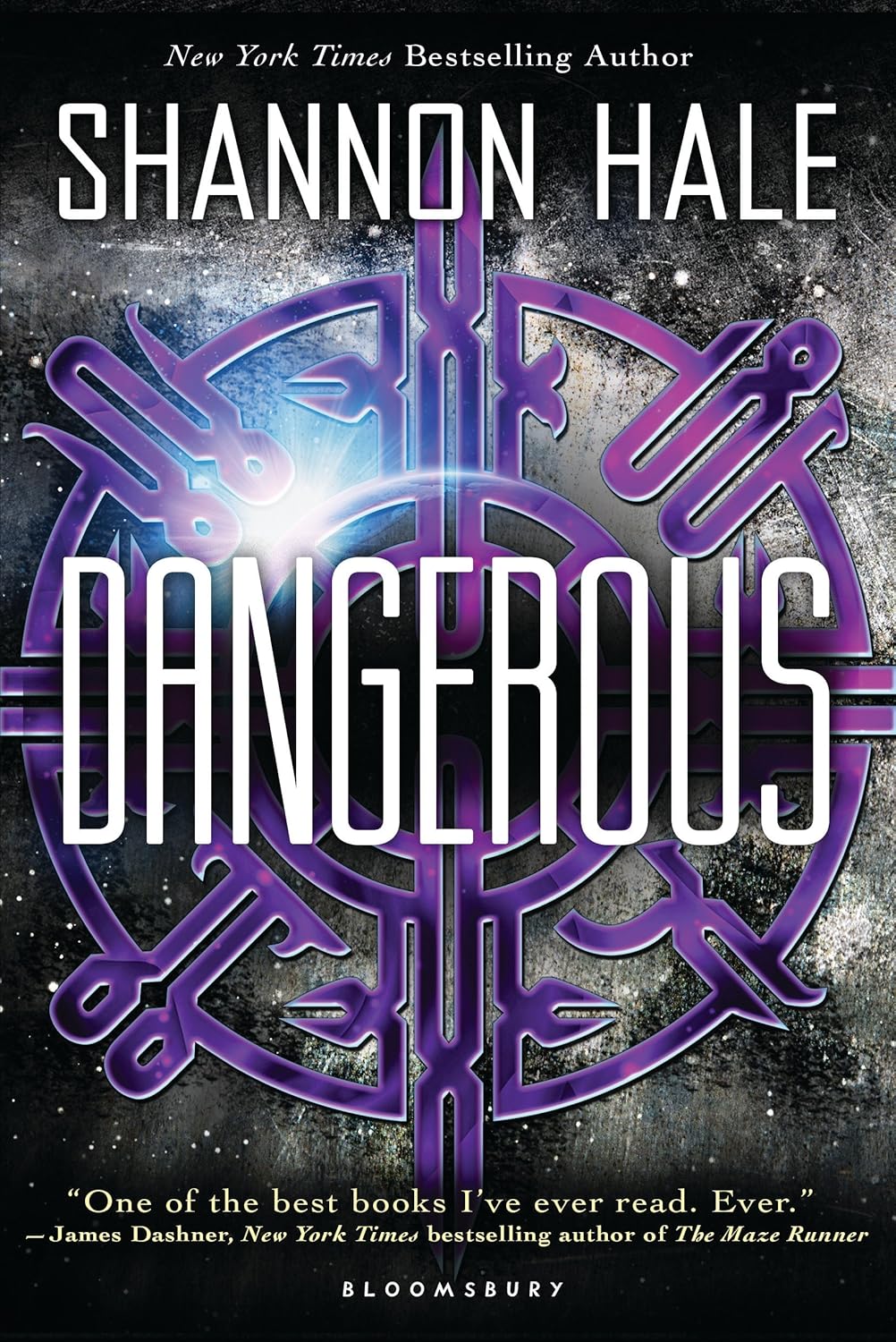
Dangerous, a new novel by Shannon Hale, is a book entirely different from her Books of Bayern series or her Princess Academy series, which are both fantasy. Dangerous reveals an entirely new side of Shannon Hale because it's basically a superhero story, with science and high-action, superpowers, aliens, and then the bad guys on earth trying to use our superheros for their own gain.
Maisie Danger Brown is an unusual girl to start with, even before anything interesting happens to her. She was born with only one hand to a Spanish-speaking Mom and a biologist Dad. Besides her missing hand and habit of speaking Spanish, there are two other things that make Maisie different from your average person. She's homeschooled and she's obsessed with science and space. So when she gets a chance to attend a space camp for teens, she jumps on it.
But Danger is her middle name and somehow can't help attracting it. First, she and four other teens at the space camp are infected by alien technology which gives them superpowers. Maisie can make anything, anything she wants, anything she can think of. It's like a dream come true, but none of the infected kids can be sure what's going to happen next. They know for certain that the infection didn't just 'happen' to them. There was a purpose, and they can all feel it. But their powers are getting out of control, and after the death of one of the new superheroes, the group begins to break up.
Can Maisie save the team of superheroes from breaking up and wrecking havoc across Earth? Can she figure out what the Purpose that's nagging at them all is? And can she trust her heart now that she's fallen in love?
Dangerous was a good book. I don't usually go in for science-fiction type stuff, but this book wasn't quite that. It reminded me a lot of The Avengers, a superhero movie. A team of unlikely people with varied superpowers come together to save the world - maybe from aliens, maybe from something else. It's an action-packed story, but Shannon Hale made it appealing with a singular heroine in the form of Maisie Danger Brown. Maisie has guts, she's smart, and through it all, she tries to do what is right - even when that's not possible to do.
There were a few things that keep me from being totally happy with Dangerous, though. I'm totally okay with romance in book, including teen romance that involves kissing, as long as the romance doesn't become the point of the entire story. Maisie's romance wasn't the focus of the book, but she and Wilder kissed way more than I was comfortable with. Despite that, I would have rated Dangerous 4.5 stars except for this one scene when she and Wilder almost went further in their romance than 'just kissing.' And after that, regardless of how good the rest of the story was, I dropped my rating to 3.5 stars.
Taking an entire star from a rating is a pretty big step, so I want to provide my reasons for that. First, coming from Shannon Hale, just the sheer amount of kissing in Dangerous was kind of a surprise. If you've ever read her Books of Bayern series, you'll know that the kisses are few and far between - and I'm not saying that's a bad thing or a good thing. It's just the way those stories went. And the amount of kissing in Dangerous was just how this particular story goes. I can understand that - doesn't mean I approve of it 100%, but I can tolerate it, and it doesn't get in the way of my enjoying the story. But then there was the almost scene, and that really bothered me.
Without getting really deep into this, I basically felt a little betrayed by Shannon Hale for doing that. One, because it was totally unexpected from her. But every writer has a right to write whatever he or she feels like, so that's not her fault. It's up to me to either put up with it and keep reading, or decide it's too much and quite. I didn't quit, but I was more than a little disappointed that Shannon Hale decided to go there. Two, I'm not a fan of that kind of content. I can put up with it, but I don't like it and it really bothers me. The third reason I was so bothered by the almost scene goes back to the fact that Maisie is homeschooled.
Now, maybe I'm overreacting and being really harsh in my judging here, but everyone should be entitled to their own opinion, and I'm just writing mine. I felt that early on, when Maisie first meets Wilder, she was being represented as a niave homeschooler who has no idea what people are like. Also, when she and Wilder are kissing within three weeks of having met each other, I thought it was going too fast and made Maisie seem gullible. Later, during the almost scene, the way things lined up and the way Maisie thought again felt like they were casting a bad light on homeschoolers. Please note that I don't judge Shannon Hale for writing a homeschooler. Nothing I noticed offended me really - I just smiled and shook my head. It's a fictional book about fictional events and people. I can bear if the book isn't flawlessly realistic.
I'm also 100% certain that Shannon Hale didn't mean for anyone to have this kind of reaction to Dangerous. She talked to several homeschoolers during the writing of the book, and had people give her feedback on how she represented them. And on the whole, she did a great job. Maisie seemed just like any normal person - and that's really the problem. Homeschoolers are (except in extreme cases) just normal people. The homeschooling didn't really add anything to the story. It's a trivial detail, and the book would probably have been better if it weren't there. When you make your character distinct in some way as big as making her one-handed or homeschooled, readers expect that detail to be vital to the story (at least I do), and homeschooling wasn't. And by having that detail there, Dangerous gets judged a certain way. Maybe all this is hogwash, but its what I thought. If you read Dangerous and have an opinion about how homeschooling and almost were written, comment below - I'd love to hear from you.
In the end, the almost in Dangerous bugs me, but besides that I really enjoyed it. It had great characters, great action, and a great plot. I discovered I have a thing for superpowers, and these were really cool! Plus the aliens were obviously not a rip-off of something that had been written before. In a genre full of science-fiction-alien-invasion stories, I think Shannon Hale has carved out her own niche with superheros and a brand of bad guys that no one has thought of before. If you're really picky about the content you're getting in a book, the almost might be too much for you, but the rest of the book is very good. I'm not a big sci-fi reader, but I liked it. The romance was stronger than suited me, but the plot itself was captivating and gives a good example of how talented Shannon Hale is. She wrote a book outside of her normal fantasy genre, and came up with something very distinct and interesting.
As a final note to a really long review - I apologize, I had no idea I'd go on this long! - I want to share this statement I found on Shannon Hale's website:
Dangerous is a "novel that asks, How far would you go to save the ones you love? And how far would you go to save everyone else?" A big question for just one book to deal with, but Shannon Hale does a good job of it.
Link to author website: http://www.squeetus.com/stage/main.html
Also, there's a post on Hale's blog where she talks about Dangerous and the main character, Maisie Danger Brown, which you can find HERE if you're interested in hearing more.
The Delirium Trilogy by Lauren Oliver is set in a futuristic version of the United States. It centers around a teenage girl called Lena, who is living with her aunt and uncle in Portland, Maine, and is on the verge of undergoing a procedure called the Cure. This procedure is mandatory for all citizens once they reach eighteen years of age, and Lena is anxious to get her's. Under the current government, love is considered a disease, and the Cure is the only known way to render one immune to it's effects. Everyone who has not been Cured is at risk.
 Delirium, the first book in the trilogy, sets the scene by introducing Lena, a fairly typical girl in all aspects except that both her parents died when she was young, leaving her to live with her aunt and uncle. Lena follows the rules that the government has set up to protect young people from the disease of love - like everyone else she's terrified of it. But before she gets the Cure, she falls in love with Alex. Alex is secretly spying on the government because he is an Invalid, one of the uncured rebels who are forced to live in the Wilds, the unexplored territory beyond the walls that protect the cities. Alex is also part of a rebellion against the government, because the Invalids believe everyone should be free to love. Lena realizes that once she has the Cure, what she feels for Alex will be gone and she will be paired with a suitable young man for the rest of her life. To escape that fate, she and Alex try and escape together to the Wilds, but they are caught, and Lena sees Alex go down after making sure she will get away safely.
I found Delirium to be a fairly decent book - not particularly slow moving or boring. I wasn't sure I liked the way the story was going, but the idea of love being a disease was new and fairly interesting, so I decided to read on. Delirium is probably worthy of 3.5 stars from me.
 The second book, Pandemonium, takes off and continues the story with an alternating timeline. Each chapter alternates between Lena's mission within Portland, spying for the Invalids, and her recent struggle to adjust to life in the Wilds. This tactic allows Lena's growth as a character to be gradually revealed from a variety of aspects - a writing strategy that I liked. While Lena recovers from her flight from Portland in the Wilds, she goes from being a heartbroken girl to someone who is stronger, more determined, hiding her love for Alex under a tough exterior. At the same time as this aspect of Lena's life is revealed, her mission within Portland also continues, and she ends up saving the life of a boy called Julian, one who strongly supports the Cure. During her attempt to keep him alive and escape from detection, she and Julian also fall in love.
Pandemonium seemed to me to be a decent story in some ways, and a terrible one in others. I admired Lena's recovery and her determination to do something about the Cure now that she knew it was evil. But at the same time as I was admiring that, I was hating her romance with Julian. I felt it was too sudden and not founded upon anything. To me it seemed like a reaction to a very stressful and dangerous situation, but not built on a real and lasting affection for each other as something other than friends. The romance seemed like a plot device meant to cause Lena further anguish more than anything else. Largely because of this, Pandemonium was only worth 3 stars.
 Requiem I approached with the hope that Oliver would turn the story around and make it come out satisfactory. Lena, Julian, and Alex (who did not die at the end of Delirium - surprise!) are working with the rest of the Invalids to make the rebellion a reality, but as the days go by, the futility of their actions seems more and more obvious. Lena is also trying to decide which she loves best: Julian or Alex. I found this particularly agonizing, since it took the entire book for her to make up her mind and she was constantly dwelling on it. Thankfully, Lena's chapters were alternated with chapters narrated by her childhood friend, Hana. Since Lena left Portland, Hana has had the Cure and is about to be married to her match, a wealthy and influential young man who is important to the fight against the Invalids. Hana's chapters provided me with some relief from Lena's brooding, and I found Hana's side of the story to be intriguing.
The ending of Requiem wasn't particularly thorough - it left all the major questions answered, but although the government had been overthrown, Oliver only hints at what the future holds for Lena, Julian, Alex, Hana, and the rest. I was somewhat dissatisfied with this way of ending the story, but I think that winding up all that had happened would have taken too long to do well, and would have ended up boring. Still, Requiem didn't meet up to my expectations, and I would only rate it 3 stars.
I happen to have reasons for my less-than-favorable opinion of the Delirium trilogy. First, the love triangle between Lena, Julian, and Alex was a disappointment to me. Stripped of most of the details, the love story went like this: The girl falls in love with a boy who represents something she's been afraid of all her life, but when they run away from everything she's ever known to be together, he 'dies'. She's heartbroken and becomes a very toughened character, but then falls in love with a boy who's the complete opposite - and just when everything seems to be working out between them, the first boy shows up again. Now the girl has to choose between two boys she loves and who still love her.
I generally don't like love triangles, and although I liked a few things about both boys, neither of them really impressed me. Put those two things together, and the combination was not appealing. The other thing which I disliked about the Delirium trilogy was that Oliver used swear words frequently - and not little ones either. That really disappointed me, because beyond that she has a very beautiful style that makes for really good reading. The swearing definitely lowered my opinion of her. And the other thing that I wasn't happy with about the Delirium trilogy is that it has many of the characteristics of a dystopian story, and I've never been fond of those.
However, there were good things about the story, or I wouldn't have kept reading past the first book. The characters were excellent, and although there were a few I personally did not enjoy, they were still well-written. Lena - though she had moments when she seemed weak - is a pretty scrappy character, and she doesn't give in when things get really bad. Alex and Julian made good partners for her in different ways, and I liked that Oliver at least made them different instead of having both love interests be nearly identical. I actually enjoyed Hana because she had more snap and fun to her in Delirium than Lena did, and in Requiem she wasn't as brooding as Lena was. The other Invalids that Lena meets were also good characters, particularly Raven and Tack, the two leaders of the Invalid band Lena joins up with in the Wilds.
My final opinion of the Delirium trilogy is this. The characters were all very good, although not all fit my personal tastes. The world - particularly the idea that love is a disease - was half of what kept me reading, because I wanted to see that resolved. However, the romance wasn't written the way I like it, and I didn't enjoy the swearing and misery that the characters had to go through. I would not read the Delirium trilogy again, but for older readers who enjoyed other recent dystopian-type stories (Hunger Games & Divergent), this trilogy might be something you would enjoy.
Link to author website: http://laurenoliverbooks.com/
Guest post by jayden robyn
Lauren Oliver’s Delirium trilogy, consisting of Delirium, Pandemonium, and Requiem, for young adults is one of the many popular dystopian trilogies of recent times, and is quite possibly my favorite young adult trilogy. This review will cover all three books.
 In Delirium, we meet Lena Haloway, a girl who is approaching her eighteenth birthday—and the “cure.” In Lena’s futuristic world, love has been declared a disease and must be eradicated. When everyone turns eighteen, they must receive the cure that renders them forever unable to love. They are then paired with someone who will be their spouse and basically live their lives as they are told. This twist on the dystopian world easily could have gone wrong, but Lauren Oliver presents it in a fashion that is very believable, and she gives us background on how her world works without ever bogging the story down.
Lena is eagerly awaiting her cure—that is, until she meets a young man named Alex. At first, Lena is wary around him; after all, until they are cured, boys and girls are segregated and do not have contact with each other except for family members. But Lena is intrigued, and soon she begins to doubt the world she has grown up in. Alex tells her about the Wilds, a place outside the borders of the U.S. and how “Invalids”—those who are not cured—live there, free to choose for themselves and free to love. Then Lena discovers that she has fallen in love, and decides once and for all that she will not be cured, and she and Alex plot a daring escape to the Wilds.
The entirety of Delirium’s 441 pages covers Lena’s journey to realizing that her world isn’t all that it is made out to be. It is relatively slow-placed, though it does have its exciting moments, and the ending is definitely a major cliffhanger. I found the pacing to be much less bothersome and the story itself more enjoyable the second time around. I would rate Delirium 4 stars.
 Pandemonium, fortunately, does not fall victim to the “second-book syndrome” that many middle books in trilogies do. I found it even better than the first. Its pacing is much quicker, and the storyline goes back and forth between the brewing rebellion during the present time and Lena’s adjustment to the Wilds during the not-too-distant past. This presentation was smooth and allowed us to follow Lena’s journey without getting bogged down.
Pandemonium also introduces several new interesting characters, including Raven and Tack, leaders of the group that Lena joins in the Wilds, and Julian, a likable young man who was raised his whole life believing that love is a disease, just like Lena. Together they take part in the rebellion that is being formed by the people of the wilds to bring down the loveless world that Lena formerly inhabited. A love triangle also begins with Lena, Julian, and Alex. I normally do not like love triangles in the slightest, but Oliver pulled it off well enough that I didn’t mind. I would rate Pandemonium, which ends with another huge cliffhanger, 4.5 stars.
 Requiem, the conclusion of the trilogy, didn’t disappoint. In this installment, the story alternates between the point-of-views of Lena and her childhood friend Hana Tate, who has been cured. Writing point-of-views, particularly first-person POVs, that sound unique is tough to do, but Oliver pulls it off well. The separate paths of the two girls eventually meet near the end of the novel, which is somewhat darker than the first two but not overwhelming. The rebellion is growing stronger each day, and Lena also has to choose between Alex and Julian, as well as reunite with her mother, whom she hasn’t seen since she was a little girl.
The ending of Requiem has been hit-or-miss with most people, and I personally liked it. Oliver wraps up the majority of the story’s loose ends, but leaves her characters’ futures uncertain while still ending positively. I wasn’t sure that I would like that, but in the end I found myself satisfied. I would rate Requiem 4 stars.

Lauren Oliver is a talented writer; her words flow smoothly and she has a unique way of describing things without ever feeling stilted or forced. I could easily picture in my head what she was writing about. Her characters are well-rounded and believable, with their own distinct personalities and motives. I liked Lena, Alex, Julian, and Raven, and while I didn’t totally like Hana, she was still interesting. Lena was probably my favorite character overall, and probably my favorite heroine of all the young adult trilogies. She is strong and capable, but she is far from perfect. I felt that she reacted believably to her circumstances in all three books. The romance is also clean.
My main complaint about this trilogy is the language. Oliver consistently uses curse words throughout the trilogy, and occasionally she’ll use big ones, too. They came often enough that I couldn’t just ignore them, and it detracted from the story somewhat. In fact, if Oliver hadn’t written the curse words, or at least not so often, I would’ve rated Pandemonium 5 stars and the other two books 4.5 stars. Overall, however, the Delirium trilogy is one of my favorites, and Lauren Oliver is still one of my favorite authors. I’d recommend this trilogy to anyone 14 and up.
Link to author website: http://laurenoliverbooks.com/
 Artemis Fowl, the first book in the Artemis Fowl series by Eoin Colfer, is about the 12-year-old criminal mastermind, Artemis Fowl. In his search for greater power, wealth, and influence, he stumbles across the existence of a civilization of magical beings - fairies, pixies, and the like. He and his bodyguard and friend Butler - actually, he's a butler, too - kidnap one of the pixies, a fairy named Holly Short. Artemis's plan is to ransom Holly for some fairy gold - but the fairies aren't about to part with any of their gold. They also want to keep their existence secret from other humans. What follows is a hair-raising episode as fairy and human genius match wits. Who will win?
If that's not thrilling enough as it is, the fairies are equipped with high-tech equipment and magic, while Artemis only has his wits. But Artemis has never been out-witted, and he's quite confident in his ability. Also, the fairies are split into two factions and are arguing about what to do about Artemis. I've never read a book that balanced a high-tech yet magical story as well as Eoin Colfer did in Artemis Fowl. If you're one of those readers who likes to try and solve the mystery before the book gives you the answers, you can try and beat Artemis Fowl, but I guarantee you won't.
The story is told from the point of view of many of the characters: Artemis, Butler, Holly, and Foaly, a computer geeky centaur. Other intriguing characters such as Commander Julius Root of the LEPrecon and Butler's little sister Juliet also appear, giving this story a wide and varied cast of characters. It's fun and has it's moment of humor. The characters are genuine and extremely enjoyable, and this story is unlike any other you've ever read. You'll never find characters like Julius Root and Foaly in another book, and you're never going to run across a mastermind like Artemis Fowl. I wouldn't have missed Artemis Fowl for the world. Pick it up. Read it. I mean, who doesn't like what happens when you mix magic and technology, fairies and geniuses?
Link to Artemis Fowl website: http://www.artemisfowl.com/