Showing posts with label mystery. Show all posts

Wednesday, September 2, 2015

Chasing Vermeer — 4 stars

If you look back through the list of books Mountain Gal and I have reviewed on this blog together, you’re going to realize that we read fantasy, at least for the most part. However, in the interest of being a helpful resource to people who read other kinds of books, I have been trying to expand my own reading to things I wouldn’t normally pick up. Because (gasp!) there actually are other kinds of books out there.

That's why today’s review is a non-fantasy book. Chasing Vermeer, by Blue Balliett, is set in modern-day Illinois, and it's about two 6th graders, coincidences, and the paintings of a 17th century artist from the Netherlands. A most unlikely combination, in other words.

Chasing Vermeer is a mystery kind of story, but not the whodunit, hunt-for-fingerprints kind of mystery. This mystery is one that has to be solved by believing in coincidence, in chance, and luck. Lots of luck. It has to be solved by looking for clues in everything, by finding connections between perfectly ordinary events that together have a significant meaning. Sherlock Holmes and Nancy Drew would never have solved this mystery—they wouldn’t have seen the clues. But for 6th graders Calder Andalee and Petra Pillay, clues jump out at them from every direction.

There’s nothing particularly unusual about Calder and Petra that makes them perfectly suited to solve this mystery, but it certainly does help that Petra is willing to believe even the most unlikely event could be a clue, and Calder is a visual thinker whose pentominoes—flat geometric figures formed of five squares—help them find many of their best clues. But besides these qualities that make them both uniquely themselves, Calder and Petra are just two ordinary 6th graders—who happen to be in the right places at the right times to solve a mystery, save a painting, and prevent a giant art fraud from taking place.

And that’s really all I’ll say. About the plot, at least.

I figured this book would be targeted toward the 8-12 range, both because of the age of the characters and because of the cover art. (NOTE: the illustrations on the inside are really great too!) However, the story is actually pretty complicated. I had to pay attention to catch all the clues and remember all the connections they had made. I also really liked the way the two characters played off each other. They’d swap ideas and put clues together really well—and they were usually way smarter about it than me. Basically, the mystery was really, really interesting, and was definitely not something you’d be able to solve until the characters did. And it was super complicated, which I think makes a mystery story that much better.

For really critical readers, here's a specific thing about Chasing Vermeer that I'd like to praise. Blue Balliett (that can't possibly be her real name!) has two very young narrators in this story, and I was very pleased with the way she handled the fact that they were solving a mystery that baffled even the FBI. At some point in the course of their sleuthing, they had to end up in danger, but I was worried that Balliett would shrink from that and keep Calder and Petra perfectly safe. But she didn’t. They ended up in very real, very serious danger, and when that happened the tension in the story went up a notch—maybe two. It made for a climax that was memorable, instead of a simple “mystery solved, bad guy in jail” kind of ending.

My final opinion of Chasing Vermeer is that it’s certainly worth reading. The story is fun, there are great characters, and a very interesting mystery! Definitely preferable to Nancy Drew. I’ve also read the sequel, The Wright 3, and that was just as good. There’s a third book that I haven’t gotten a chance to read yet, but given the track record of the first two, I’ll vouch for it being a great book.

Link to Blue Balliett’s website: http://www.blueballiettbooks.com/
And since her website is kinda tricky to maneuver, here’s the link to her Amazon page as well: http://www.amazon.com/Blue-Balliett/e/B001IGLPXG/ref=sr_ntt_srch_lnk_1?qid=1437576663&sr=8-1#

Tuesday, August 4, 2015

The Seer of Shadows — 5 stars!

I’m not usually a horror type of person. I don’t like read or watch things that are bound to give me nightmares. But I have to admit that I do read some scary stuff. For instance, The Spook’s Apprentice series has some pretty frightening imagery in it, and The Screaming Staircase by Johnathan Stroud was a poor choice of reading material right before I went to bed. But I liked both of those series despite that, because although they scared me, they didn’t deliberately set out to terrify me permanently right from the beginning. A good scare was just part of the story.

I say this because recently I read another book that was good, but at the same time a little scary. The Seer of Shadows, written by award-winning children/YA author Avi, was a book I picked up for totally casual reading. It’s under 200 pages in hardcover, and I fully expected it to be a quick read on a rainy afternoon that would be forgotten in a few weeks.

Not so. The Seer of Shadows is a story told by Horace Carpentine, and despite his (I think) disastrous name, he’s actually a really good guy. Horace is apprenticed to a little-known photographer who thinks very highly of himself, Enoch Middleditch. One day, Middleditch is approached by a wealthy woman called Mrs. Von Macht who requests a photograph to be taken of her, and for some very curious reasons. Her claim is that she wishes to comfort the spirit of her dead daughter Eleanora by placing the photograph upon her tombstone. But the Von Macht’s black servant girl, Pegg, tells Horace just enough to make him wonder if her story is entirely true.

Strange things begin happening to Horace as soon as Mr. Middleditch is employed to take Mrs. Von Macht’s photograph. Horace is allowed to take his first photographs while at the Von Macht’s lavish home, and when he develops them, a frightening figure is revealed—Eleanora’s ghost! The more photographs he takes, the clearer her figure becomes. Worried, he seeks out Pegg to find out more about Eleanora, and too late they realize that his photographs are evoking Eleanora, allowing her to return as a spirit. And Eleanora’s spirit is bent on one thing—revenge upon the Von Macht’s! If she goes unstopped, she will murder them both. Horace may be the only one who can save them, if he can just find a way to send Eleanora back.

This story is set in New York during the year 1872, a time when photography was still a pretty young art. I really liked how Avi captured the mechanics of early photography in this story, right down to the chemicals that were used to develop the pictures, and even how those early cameras were put together. It was very impressive and very authentic to the time period, which is part of what made the story so easy to get sucked into. Photography was very important to the story, and by getting it right, Avi makes you feel like you’re there, in the story.

As for the scare factor, here’s what I have to say. Obviously, The Seer of Shadows is a ghost story, and some people are scared by that kind of thing. I didn’t think ghost stories could really get to me (then again, I don’t read many) but the last fifty pages of The Seer of Shadows were definitely scary. I can’t lie about that. There actually was a point where I had to shut the book and do something else for about five minutes before I could bear to go back to it. So, yes, I would say The Seer of Shadows definitely had some horror elements in it. Words are powerful. There are some books you just can’t read before bed.

But I still liked it—and I mean, really liked it. I think that has to do with the fact that Avi could scare me, using nothing more than words on a page and my own imagination. The fact that he could do that, and do it to the point where I had to remove myself from the story before I went on, is really a testimony to the quality of his writing and story-telling. Not many books can get you emotionally involved in the lives of completely fictional characters in completely fictional events. The ones that do are the ones that you’re not going to forget, and that you’re going to read and reread over and over again. And to me, The Seer of Shadows is one of those books.

That said, I will admit that The Seer of Shadows is probably not for everyone. The scare factor is very real, and for some people it would be overwhelming. It’s taken me a while to get over being scared enough that I could admire the fact that I was scared. It’s probably not the best book to give your twelve-year-old right before bedtime unless you want to give them nightmares. But for a mature reader who can handle it, I’d say: “Go for it. It’s worth it.” Horace and Pegg are great characters, and the mystery of who Eleanora really was and what happened to her adds a lot of depth to the story.

Link to Avi’s website: http://www.avi-writer.com/
Link to Avi’s blog (I’ve read it—great stuff for fans and writers): http://www.avi-writer.com/blog/

Friday, April 10, 2015

The Glass Sentence ~ 3 stars

     The Glass Sentence, by S.E. Grove, is a book that I've had on my read-and-review booklist for a month or two now. I saw it on Amazon and the little blurb about it there looked promising - some pirates, some sailing, a lot of maps, some sort of intricate setting, that kind of thing. It looked like it was going to be a really sweet story, a really interesting beginning to what could be a very interesting trilogy. When I saw that the library had gotten it, I was very excited and of course checked it out.

     The story began fairly interestingly, introducing a world that has been torn and fragmented by the Great Disruption, a devastating event which caused the Ages of the world to fluctuate and change so that all over the world people are trapped in different Ages. New Occident, previously known as the American Colonies, is home to Shadrack Elli, a world-renowned cartologist, a man who makes it is business to map the world and the Ages in it. Living with him in their home in Boston is his niece Sophia Tims. Sophia is effectively an orphan after her parents disappeared on an expedition when she was three. Raised by Shadrack, Sophia has learned a lot about maps, mapmaking, and knows more than most thirteen-year-olds about the Great Disruption and its effects. 

     When her uncle Shadrack is kidnapped by a cult seeking the location of a legendary map called the carta mayor, a map that is said to chart all the Ages of the world, Sophia is the only one who begin the search for him. Helped by Theo, a refugee from the Baldlands, Sophia sets out on a quest to track down her uncle. Along the way they are pursued by his kidnappers, because Shadrack has entrusted her with a valuable map that is key to finding the location of the carta mayor

     With this kind of plot, the story sounded good - very good, in fact. I was very, very excited to read it, and maybe my high expectations are part of why I was so disappointed by this book. From the moment Sophia left Boston, I grew more and more confused as to where she was, and even more importantly, what she was doing there. With all the things going on - being attacked by Sandmen, throwing in with gentlemen pirates, and running across Theo's enemies - it was hard to keep track of the main thread of the story and the reason Sophia was going where she was going. Also, because of the Ages being all mixed up and varying from place to place, the world was fractured and cultures in these different Ages were vastly different. Normally this would make for an incredibly rich setting for the story to take place in, but I felt like there was so much extra detail thrown in that the story would occasionally be derailed when some new fact of the particular Age they were in had to be explained. The story would have been simpler and easier to read if some of those extra things had been pulled out and saved for a moment when they would really be important and not just peripheral information.

     The other thing that really disappointed me in this book was the lack of a good villain. Blanca, the mysterious woman who has Shadrack kidnapped, lacked real power. Sure, when she was first introduced into the story, I expected her to be a truly terrifying villain who would stop at nothing to get what she wanted - unlimited power and control of the carta mayor. Not so. Although Blanca seemed like she would be a thoroughly heartless villain, all of her casual acts of cruelty that would have made her seem truly evil never really had that effect because Shadrack never seemed to feel really afraid. He was too much like a robot in my mind, barely touched by his emotions and forever thinking about everything without really feeling anything. S.E. Grove set her up to be a magnificent example of pure villainy, but she tore her down just as quickly by failing to make the characters react as if she were really that terrible. Because of this, Blanca never manages to be the villain who would have made the book really stand out.

     However, the part about the Great Disruption and the maps was very good, the maps in particular. S.E. Grove definitely used her imagination in concocting this setting and the numerous details of Shadrack's trade. All the different kinds of maps - glass maps, metal maps, sand maps, even water maps - add such a unique dimension to the story. Also the emphasis that everyone in this world places on time. Since the Great Disruption, time and how it is measured has become a very important part of everyone's life. That's not a concept that I've seen discussed in a lot of books, and it adds a whole new dimension to The Glass Sentence. I can definitely say that the maps and the issue of time were my favorite parts of this book.

     I also admire what S.E. Grove did with Sophia. She has no internal clock, and she finds it very hard to keep track of time. For her, hours can pass by in a matter of seconds, while a minute or two can drag on forever. In order to keep track of her own memories and life story, she has to map the events of her days, giving her a record of what has happened. In fact, its the fact that time has no hold on Sophia that makes it possible for her to do what has to be done to save the carta mayor from Blanca's clutches and keep the Ages of the world from colliding and destroying each other. 

     In the end, I give this book three stars because although it could have been really good, the lack of a strong villain character and my difficulty in keeping track of where things were taking place made this book less satisfying than I expected. However, I won't judge it too harshly, since it's just the first book of a new trilogy, called The Mapmakers Trilogy. A first book is only intended to start setting up the bigger story, so although I wasn't entirely happy with this first book, some of the issues I had with The Glass Sentence will most likely be resolved and dealt with in the two books to come. It's at least worth 3 stars, and I would definitely point you toward this book if you're interested in quest stories, imaginative settings, and fictional imaginings of the world.

Sunday, January 25, 2015

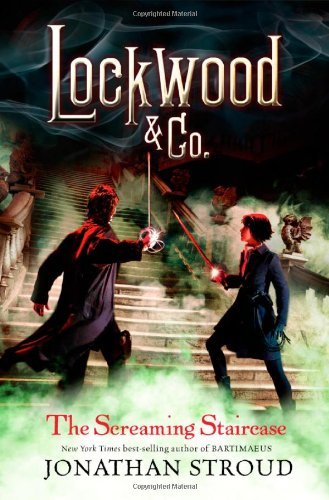
The Screaming Staircase - 4.5 stars

Second edition cover
     The Screaming Staircase by Johnathan Stroud is another new book I picked up recently. Johnathan Stroud wrote the Bartimeaus Sequence - I reviewed the first book in that series earlier. I've liked most of what I've read from Stroud. A few of his stand-alone novels didn't appeal to me much, but I've always liked the Bartimeaus Sequence, so when I saw he was writing another series, I gave it a go.

     The Screaming Staircase is the first book in the Lockwood and Co. series. It could be only a trilogy, which would be a shame, but since it's not finished yet - the second book in the series, The Whispering Skull, only came out September 2014 - I don't know. But so far, I've really enjoyed the first two books, so I'm probably going to be getting myself any sequels he comes up with.

     This story is set in London. A sinister Problem has been troubling the world for nearly fifty years now. All manner of ghosts and spirits have begun to appear in rapidly increasing numbers, and they don't appear to be friendly. Unfortunately, only young people have the ability to perceive these spirits. Many different agencies have sprung up, employing hundreds of adolescents and children to find and destroy these Visitors, as the spirits are called.. Lucy Carlyle is a brave and talented young agent with the ability to hear the Visitors. When she teams up with clever, charismatic Anthony Lockwood and his mildly repulsive assistant George, they all have hopes that the agency is about to make its mark on the world.

     Unfortunately this is not to be, and after their latest case ends disastrously with a house going up in flames, Lockwood and Co. face the possible end of their new agency. To save it, they must brave the most dangerous haunted house in London, perhaps in all of England. Combe Carey Hall has a reputation of spirits and hauntings that stretches back several centuries - long before the Problem really began. Can the three intrepid agents survive the horrors of the Screaming Staircase and the Red Room? Can they put an end to the haunting of Combe Carey Hall, or will they be the next three lives the forces of that house have taken?

     The Screaming Staircase was definitely a page-turner. Stroud balanced the comfy relationship of the three-person agency with a lot of fast-paced action and really dangerous situations. I was also really captivated by the originality of the plot. The story is set in slightly post-modern London, but it wasn't sci-fi at all. Something else that I found was interesting was the fact that agents use rapiers to fight Visitors - what's not to like about some dashing teens with flashing, silver-coated blades? Furthermore, there was definitely a mystery element to this story, and although the clues were there, I was kept deliciously guessing the entire time. I think you can agree that that's a mark of very good story-telling.

First edition cover
     As for the characters of The Screaming Staircase, they display Stroud's trademark sarcasm and humor. If you're like me and couldn't get enough of Bartimeaus in the Bartimeaus Sequence then the characters in Lockwood and Co. have a taste of that same sharp wit and irresistible, careless charm. Lucy is a very plucky and extremely admirable young lady. I didn't expect her to be my favorite, but she is, hand's down. It's also hard not to be charmed into liking the irrepressible Lockwood, and though I still have my doubts about George, he turned out to be a good egg after all. 

     Another mark of Stroud's ability to write very, very good stories is the Visitors. The descriptions of ghosts, spirits, and other things not quite of this world that stem from the Problem are incredibly riveting, and though I really should say 'realistic' that's what I'm going to go with. I honestly wished I hadn't started to read the climax after dark, because what they encountered in the Red Room was actually pretty scary stuff. If you've got a problem with getting emotionally involved with a book and getting as freaked out as the characters are, then you'll probably want to save The Screaming Staircase for strictly daytime reading.

     Other than that, The Screaming Staircase was a captivating and fun read from an author I know and trust to write good, high-quality material and tell intriguing stories. I'm actually really impatient for the next book to be published.

Link to series website: http://www.lockwoodandco.com/

Saturday, January 24, 2015

Ascendance Trilogy - 5 stars

     In these past few months, I (Noodle) have been reading some new books, ones I see suggested on the blogs I follow or that I find at the library or on Amazon. Some of those have gotten reviews, and more reviews of these new books are coming still. For instance, Poison is a book I found on another blog, and Snow White and Rose Red and The Grimm Legacy were both stumble-upons. As you can see by recent reviews, I have liked some of these new books I've been reading, while others have been duds. But just a few weeks ago, I stumbled upon a real gold-mine.

     The Ascendance Trilogy, by Jennifer A. Nielsen has suddenly become one of my very favorite trilogies. Ever.

     It's going to be hard to review this trilogy, though, because a lot of what makes it good is that it kept me guessing the entire time. Not just in the first book or the second, but the whole time, in every book. Furthermore, part of what makes this trilogy so brilliant is the slow reveal of secrets. I actually sort of ruined one of the biggest secrets of The False Prince for myself by reading the little summary of it that's up on Amazon. So the most important advice I can give you about this series is: Don't read anything that's been written about the books. Basically everything will be some kind of spoiler.

     I know that sounds weird, but it really is true. 

     With that kind of warning, I'll try and do my best to write some sort of review of this trilogy. It won't be my best, or my most thorough, but I'll give it a shot.

     First of all, the Ascendance trilogy is one of the most impossible series to put down. It's one of the most suspenseful stories I have ever read. And in my book, any story that I hate having to put down and step away from is one that's worth reading and rereading. Secondly, I can't and won't write much about the events of The False Prince, The Runaway King, and The Shadow Throne. It would give away way, way too much. But I think I can safely give a little starter for The False Prince, just so you know what you're getting into when you start reading. Because I know you will.

     Sage is an orphan boy, quick on his feet, quick with his tongue, quick with his hands. A few days before he turns fifteen, a nobleman called Connor buys him as a servant. But instead of serving tables for the rest of his life, Sage has become a part of a daring scheme that Connor has concocted. A scheme which treads very close to being treason. Sage has no choice but to cooperate with Connor, however, because if he doesn't, he'll never be heard from again.

     Sage's secrets are slowly revealed all the way through the first book,and you never quite know what he's getting at and what his plans are until the very last pages of the very last chapter. I can't/won't say a word about the other two because that would give away way too much of the story, but they're very bit as good and suspenseful as The False Prince. 

     I can say a few things about the characters of the Ascendance trilogy. Sage, the main character and narrator, is funny, quick-witted, and probably the smartest fictional person I've ever had the pleasure of reading about. He's very distinct, and I was constantly on that fine line between laughing at his jokes and groaning at his seemingly stupid mistakes the whole time I was reading. Sage is genuine. He has a good sense of what is right and wrong, and although sometimes he seems like a no-good thief, he's probably one of the most honest people in the entire trilogy. He's also the kind of person that naturally takes the lead and comes up with the ideas and plans. Sage is what makes the Ascendance trilogy as good as it is. They wouldn't be the same without him. 

     Other characters, such as Imogen, the mute serving girl, Mott, Connor's bodyguard, and the other two orphan boys, Tobias and Roden, are also incredibly varied and unique. Nielsen did an amazing job when she created them. They're complex and well-rounded characters who all add so much to the story just by being there on the pages. 

     As for setting, there are king and queens, as the titles should indicate, but the story isn't set in a medieval world. I suppose I would have to say it has some of the characteristics of 14th century Europe. There are swords and chain mail, but there was also the one cannon, so it's not strictly a Middle-Ages type of setting. And although it qualifies as a fantasy story, there is not magic - Sage gets out of every one of his scrapes through sheer luck and his sharp mind.
     In the end, I have to say that in the Ascendance trilogy, Jennifer A. Nielsen did a wonderful job of bringing together a cast of unforgettable and entertaining characters, a complex and mysterious plot, and a mastery of the art of suspense. I can't speak highly enough of them - though maybe that's obvious by now. They're complicated enough to be satisfying for adult and teen readers, but there's so much action going on all the time that my younger siblings will probably like them a lot if I can just get them to read them. I rarely advise people to buy books, especially when it's so much easier to just check things out from the library. But with this trilogy, I'm going to make an exception. These are definitely worth buying so that you can have them around all the time. If I could rate higher than 5 stars, I would.

Link to author website: http://www.jennielsen.com/